
Do computers remember faces better than our professors?: Facial Recognition Technology in the College Classroom
By: Hana Thorson
Published July 12, 2026
Find my name, sign, pass to the next person. This is how professors have often taken attendance in class. It is simple. Only one piece of paper that takes less than five seconds to verify your attendance. Ideally, this would be the norm: your professor would attach a name to your face and know you personally. When I found out how my partner’s engineering classes took attendance, I was appalled.
The professor would start his lecture non-stop, with no care towards the students or their attendance. In the background, the professor’s laptop would circulate through around 70 students, and each student would show their personal QR code and full face to the camera. As this system is built by the professor himself, the technology is not perfect- it takes a few ten seconds to recognize the student. One single laptop turned real human connections between students and professors into plain numbers. I immediately thought of the telescreens in George Orwell’s iconic dystopian novel, 1984.
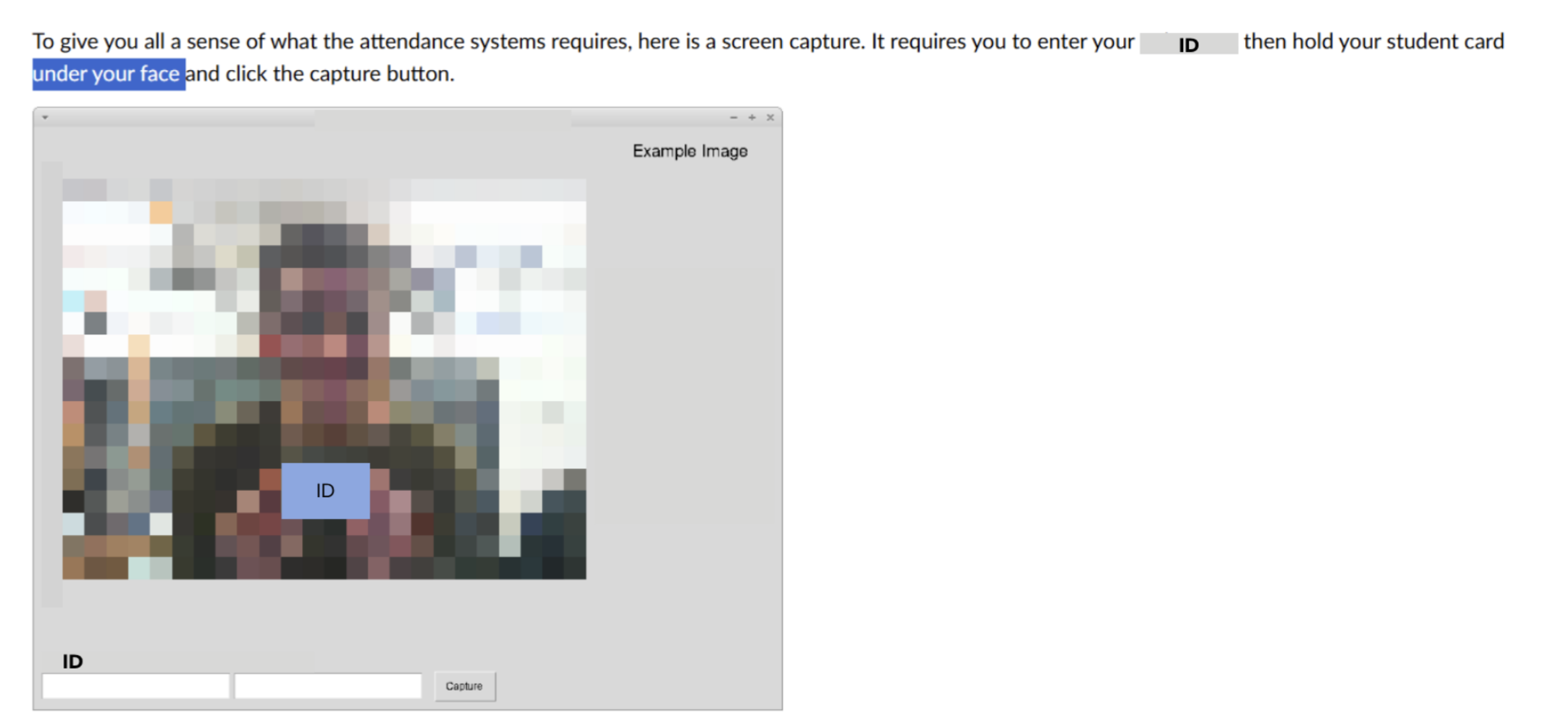
(Another) Attendance system used at a Michigan college
In the age of rapid advancements in technology, facial recognition technology (FRT) is starting to enter our classrooms. With Palantir’s partnership with ICE to retailers utilizing FRT to find people of interest, this leaves students in a vulnerable position where we have to wear masks to protests, worry about freedom of speech, and pray that ICE does not show up at the front door. At the university level, there are no safety nets protecting students from facial data collection in class- students only result in forcing themselves into trusting the professors who they barely even know, to use their faces as data.
Facial recognition technology (FRT) uses software to determine similarity between two facial images, which can be used for many purposes. FRT algorithms use facial features like nose shape, jawline, and eye distance to search for similarities in its database (CSIS). FRT originated in the 1960s as a “man-machine” system to identify facial features from a computer. This technology evolved from manual input to measure features to automatically due to developments in computer vision. Facial recognition technology is commonly used for surveillance and security purposes (Harvard Science in the News).
A study by the University of Michigan Ford School of Public Policy (published in 2020) recommended banning FRT in the classroom, citing the risks of racism, breach of privacy, and punishing “non-conformity”. Specifically, additional studies have concluded that FRT tends to produce inaccurate results of data involving black populations. Even heavily invested FRT has cases of inaccuracies, as Amazon’s FRT, Rekognition inaccurately matched 28 members of congress as people who have committed a crime. Again, this primarily affects people of color, as 40% of the wrong matches were people of color compared to 20% of the members being affected being a person of color (ACLU). Inherently, there is no perfect FRT. Professor Parthasarathy, a professor of public policy and director of the Ford School’s STPP (Science, Technology & Public Policy) program states that “prematurely deploying the technology without understanding its implications would be unethical and dangerous” (STPP, University of Michigan). Overlooking holes in data that could disproportionately impact marginalized communities perpetuates pre-existing systemic racism. For instance, as Black people experience a disproportionate level of academic punishment compared to their white counterparts, the potential errors in FRT could subject people in those communities to unnecessary punishment.
The ethical implications of consent ought to be considered as well in using FRT to take attendance. When students sign up for a class, they would have limited knowledge on how the class operates, including how the attendance system works. Typically, attendance policies and systems vary by professor; some use i-clicker, some use paper- it is unpredictable. Imagine the first day of class, attending a class taught by a professor you never had, only to scan your face just to get attendance points. How could you have predicted that your face is going to be used as data? How could you challenge the system without ruining your chances to get a good letter of recommendation? The use of FRT is concerning more than its inaccuracies, it is also about the lack of options for students to opt out of them.
Although these technologies are meant to ensure safety, this backfires, as student mental health is impacted by surveillance-adjacent technology being implemented in classrooms. The Center for Democracy & Technology reports that in K-12 institutions, 60% of students believed that “I do not share my true thoughts or ideas because I know what I do online is being monitored” (CDT). For the use of attendance, students are recorded who they are, where they are, what their student ID is, and possibly more. Without knowing the full intentions and who has access to the data, students would feel vulnerable- especially given the current political climate.
Universities ought to ban third-party and professor-made systems for attendance purposes, as it destroys the very fabric of obtaining an education in a safe environment. Again, no FRT is perfect enough to be entirely accurate and also brings into question the purpose of student IDs. Students ought to consistently question what we interact with. One of my professors always (sarcastically) pretends that the Epson projector is a spy camera, and noted that he does that because it is important for us to be self-aware of the environment we are in. We need to make progress whether that comes in the form of changing the classroom attendance system or demanding institutional change on banning FRT, before it becomes a widespread issue.
By: Hana Thorson
